

Last month, I attended eMerge Americas hosted by Melissa Medina in Miami. The conference showcased South Florida’s burgeoning innovation engine, with startups promoting groundbreaking tech in healthcare, defense, AI, and hardware. An equally impressive plenum of speakers included household-name brand CEOs, generals, influencers, and even the President’s son. Everyone present felt the energy buzz, from the opening act to the concluding cocktails. Clearly, the nexus of innovation is beginning to shift away from the Northern coasts down to the (tax-free) Sun Belt.
Emerge opening ceremonies in Miami Beach Convention Center, April 2026.
Walking the floor, I sought out robot companies in this alligator alley. Amid the mix of drone and autonomous vehicles, Rovex, an autonomous hospital-bed startup, stood out. The novel innovation was the brainchild of emergency room doctor David Crabb. The doctor was charged with overseeing his department, tackling bottlenecks in moving patients through the system. One of the most glaring examples of waste was the length of time it took for patients to be seen by the imaging staff. As it turns out, the entrepreneur discovered it took “over an hour to get 200 yards down the hall.” This led to high rates of patient dissatisfaction, revenue loss, and increased worker compensation claims.
The medical innovator explained, “Transporters have a really tough job. They have one of the highest injury rates of any job in the United States, and a very high turnover at some institutions. They leave in about six months, 100% turnover in one year. And so, I started looking for ways we could move patients autonomously. And then we settle on having something that they can grab onto, stretchers, wheelchairs, beds, etc, and tow them along safely down the hall so that you can speed the process up of caring for the patient and get the workers back to the bedside being able to take care of patients hands-on, rather than just pushing stretchers and beds around. You’ll always need a human touch in certain areas, especially with patients who are altered or anxious around things like automation.”
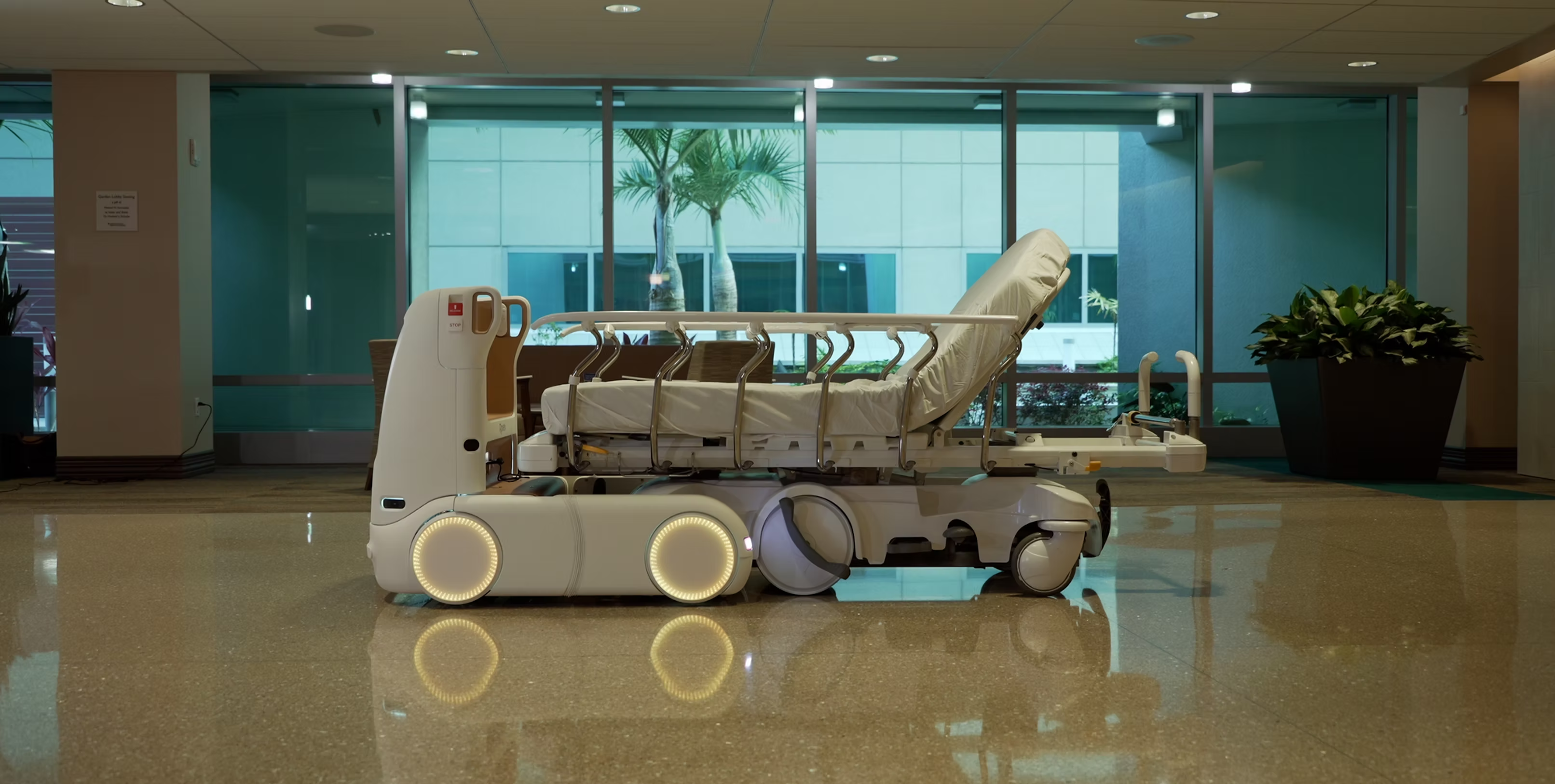
Rovex announced the first pilot of its hospital transportation system in Florida. Credit: Rovex
Rovex is a complete autonomous patient transportation system that works with existing beds and gurneys. It has a robust obstacle avoidance system to safely navigate down hallways, but as Dr. Crabb shared, its intellectual property is its towing hardware: “One of the core pieces that we’ve developed in-house is around how we grab and integrate with caster wheels, free-spinning wheels. It’s our ability. We’ve gone through four to five different iterations of how to safely and efficiently grab them with good control, quickly, and maintain good control over the stretchers, wheelchairs, or beds as we move.”
He continued to outline how his data layer could eventually be his most powerful asset, “The data is probably the biggest opportunity in that space. There are only so many [robots] out there moving around autonomously, so we’re continuing to build our algorithms to do that safely. Social interaction with people as they’re going through can be chaotic. Healthcare workers have an endless list of needs. So I’d say the data is a really important part.”
The doctor further stressed, “I think the number one consideration when you’re moving around is that this is a vulnerable population. You have to do it safely. You can’t move quickly. You have to make sure the patient is in control and still feels in control of what’s going on, so give them that control to make sure they feel safe.” He passionately continued, “As a clinician, our number one priority is patient safety first, do no harm. It is my own ethos as a physician, so the first thing we install is an emergency stop button for the robot, as well as an emergency release to make sure you can grab it and move it out of the way as easily as possible.”

Rovex’s product is shown autonomously navigating hospital hallways. Credit: Rovex
The Robot Report reported last month that Rovex received a major endorsement when BayCare Health System announced a pilot program with the startup to test its robots in real-world settings at Morton Plant Hospital in Clearwater, Florida. The hospital plans a phased program to evaluate how Rovex’s robots will move through the hospital and integrate with existing workflows, with early testing focused on navigation rather than patient movement.
BayCare’s Vice President of Innovation, Craig Anderson, said, “Delivering better patient care requires innovation across every aspect of hospital operations.” Anderson’s team indicated that the goal of the pilot will be to evaluate whether Rovex can be scaled across its 16 facilities in West Central Florida to increase efficiency and maintain safety.
“What’s most compelling about this pilot is the chance to closely evaluate and learn,” said Dr. Chris Bucciarelli, BayCare’s chief medical officer for ambulatory services. “By studying how robotics may support patient transport in a real hospital environment, we can better understand how to design care systems that support both patients and staff.”

MOVED (Autonomous Driving Hospital Bed), CES 2025 Honoree in Digital Health. Credit: Consumer Technology Association (CTA)
While Rovex has developed a novel click-and-tow platform, it is not the first company to revolutionize patient transport. At CES in 2025, MOVED unveiled “an autonomous driving bed designed to transport surgical patients efficiently via dedicated elevators, ensuring privacy and cleanliness.” While this futuristic, almost Trekkie-like form factor caught a lot of attention in Vegas two years ago, there has been little news from its South Korean creator, OGGMA, since. Additionally, hospital hallways are already crowded with robots providing logistical support for pharmaceuticals, equipment, and linens, including Aethon, Relay Robotics, and Diligent Robotics (which was acquired by Serve Robotics in January).
The broader opportunity in patient transport was further underscored this past year at Endless Frontier Labs, where I was introduced to Janis Münch of Sphaira, the inventor of Moby, a mobile protective transportation system complete with air filtration.
As Münch explains, “Medical isolation is either you’re immunocompromised or highly infectious. Now, what we did was develop a mobile protective bubble on wheels. It’s a medical device in Europe. We’re undergoing FDA approval, and this has been in use for 1.5 years at Charité – Universitätsmedizin Berlin, arguably the most famous European hospital. We are now doing a clinical study with Stanford Children’s Hospital.”

Sphaira’s Moby in use in Germany for cancer patients at Charité, Universitätsmedizin Berlin. Credit: Sphaira
Münch continued to outline his long-term plan to create fleets of autonomous patient and people movers, building on Moby’s success. This strategy comes on the heels of its October 2025 announcement of a development agreement with the Mayo Clinic for autonomous patient shuttles.
As the German entrepreneur elaborated, “So the idea is a pod, a one-person shuttle. It’s an autonomous wheelchair with passive protection. We map the building beforehand to create a digital twin, and then it drives through the building, moving in every direction.”

Rendering of Sphaira’s new autonomous patient shuttle. Credit Sphaira
When I inquired why he chose to focus on an autonomous chair versus a bed or gurney, Münch retorted, “It’s actually been more manageable, because we’re only going in the main hallways right now, but when you start thinking about doing the autonomous bed, we would need a bigger partner. I don’t know, a Stryker or so would be wonderful at one point, once our robotic infrastructure layer is installed. You have to get into every room, and this is a much bigger effort. So we’ve already put a lot of thought into this. We haven’t come up with the perfect solution yet, but our first step is the parts, which brings us into the hospitals, so we are already there, and then we can think of all kinds of use cases, and then expand our infrastructure.”
All the founders in the space boast of cost savings, increased revenues from greater hospital efficiency, and improved patient outcomes. However, Sphaira’s chief executive stated it best: “An average patient transporter, depending on the region, is somewhere around $43,000 a year. And when you look at how patient transport works, and you analyze it, you always have a peak during the day. Most are in the morning, with some around noon, depending on how their operations work. Now these peaks are staffed with two or three shifts of patient transporters. That means one of our units can replace two to three patient transporters, which really puts us in a completely different league from a unit perspective. Most (hospital) robots are supportive, increasing efficiency by 5%, 10%, or 15%, whereas we’re increasing efficiency by 200 to 300%. That’s really the core difference here, and that is also why it is an easy sale.”

Sphaira’s new autonomous patient shuttles navigate hospital hallways. Credit Sphaira