
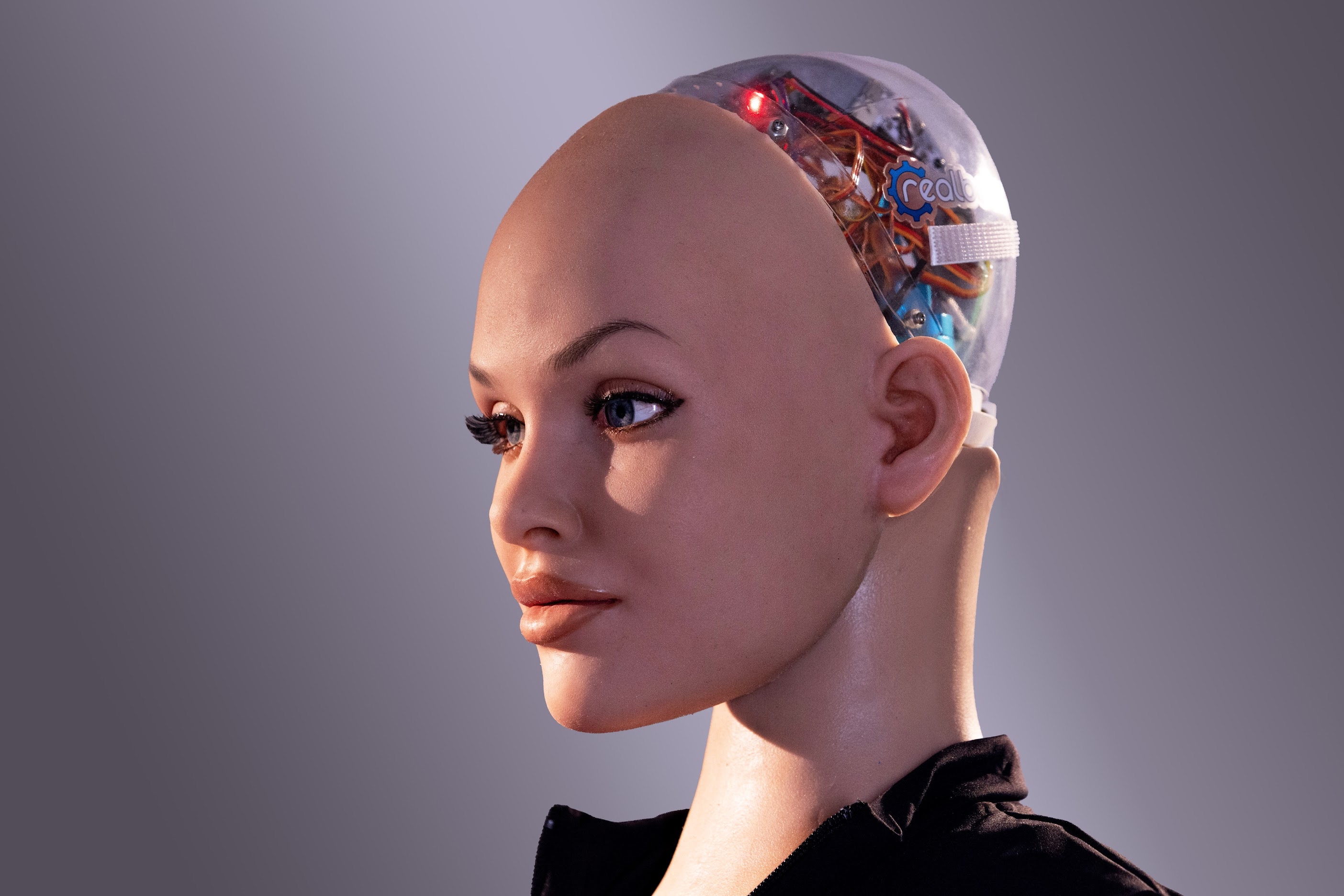
Walking through the North Hall of the Las Vegas Convention Center last month, one was surrounded by humanoids. The majority of this mechanical theater came from China, with some standouts from Europe and the United States. One CES booth that drew attention featured RealBotix, presenting human-like models distinguished by their attractive facial features and lifelike skin. The company, which originally started as RealDoll (an adult AI intimate-companion retailer), was now marketing itself to the industry as a next-generation customer service provider. Understanding this pivot requires a deeper dive into the startup’s history, the ethics of AI companions, and an analysis of what many would deem a step towards the uncanny valley.
Humanoid Robots at CES 2026. Source: Zoom Vantage
Last week, I sat down with Andrew Kiguel, the Chief Executive of RealBotix, to discuss the new direction. He reflected, “When I met Matt (McMullen, the creator of the RealDoll), he started adding mechanics and AI into the (sex) dolls. Remember, RealDoll has been around for about 25 years, and when I saw this, Matt needed capital. I had capital. RealDoll was so completely different from what anybody else on the planet was doing in the robotic space. I said there’s a clear use case here for companionship and for people who are looking for that type of intimacy, and so we did the transaction.” In July 2024, Kiguel, through his public shell, Tokens.com, acquired RealDoll (specifically its parent company, Abyss Creations) to form the publicly traded RealBotix (OTC: XBOTF).
Post-merger, Kiguel became the CEO and began charting a new path for McMullen’s vision to expand into new categories by bifurcating the company into two enterprises. The first is a direct-to-consumer business, Abyss Creations, that markets intimacy devices, such as its original RealDoll product line. The second, lesser-known, is RealBotix’s business-to-business robots for hospitality, casinos, retail, and other customer service use cases.
Kiguel stressed, “Realbotix robots are not capable of physical intimacy. That’s not what they’re made for. But what I started seeing is that there are a few things that make these robots entirely unique. So number one, they look very human. I also realized that we can run any AI through the product. So we can run our AI, which is more social and tailored to someone’s needs, and we can also run ChatGPT. So you can plug that AI into a robot or even digital avatars and use it to order room service, book a massage, or a restaurant reservation.”
While customer service robots have been employed for over two decades, I began thinking about the first use case of companion bots, beyond physical pleasure. Are there any other use cases for McMullen’s original concept? To explore this further, I reached out to Rabbi Daniel Nevins, a leading religious author on AI ethics.
The Rabbi mused, “I think these romantic robots might make us less able to be in a relationship with a real human being. Now, maybe I’m wrong. Maybe there are some people who are so antisocial that this will train them to have a conversation. And of course, there’s dementia care as well. And you know, it’s so hard to get good care for these people, like an aide who’s going to sit with this woman all day long and answer the same question over and over again. And you know what, a robot that could express affection and warmth and endless patience. I mean, there’s a place for that!”

NY Times Magazine, “The Way We Live Now,” a photo essay about AI chatbot relationships (touching one in five Americans). Source: The New York Times
I questioned Kiguel about whether he planned to enter the home space for child care or aging. He shared, “So when it comes to children, we’re having conversations with some schools with respect to using these as tutoring assistance, because our robots speak various languages. It’s a way for AI to provide value when a teacher or TA may not be available, but we would never market our stuff as a babysitter, caregiver, or emotional support for anyone under 18. Frankly, I question anybody who would want to use a robot to babysit their children.” In this way, RealBotix is perhaps more conservative than Musk’s plan for Optimus.
Kiguel continued, “When you look at the other part of society, you talk about things like longevity, there are studies that have come out that say, it’s not just about exercise and eating well, but there’s this whole concept about your social network. And so I view the AI, whether it’s in a digital form or in a physical form, as an assistive tool for people who are suffering from loneliness. It’s about improving the quality of life. If you’re a lonely senior, you’re by yourself, you’re widowed, you’re not going to be going on Tinder dates at 75, right? If you are incapacitated in a home, if you have social anxiety, PTSD, if you’re geographically isolated…”
The RealBotix CEO elaborated that he’s been approached by individuals in the US Military to use their robots for therapy to address combat traumas. He also shared with me that trucking fleets are looking into their products. “I’ve had trucking companies approach us. Truckers who have to do 30-hour drives and are alone, so we view what we’re doing in that area as an assistive tool. We’re there to provide emotional support, as opposed to sex.”
As of February 2026, OpenAI has 13 lawsuits filed against the company for encouraging users’ dangerous behaviors, including suicide and murder. Many of the claims cited that ChatGPT 4.0 provided greater affirmation and validation of destructive ideation, even offering a how-to guide for executing the task. I nudged Kiguel about the safety guardrails he is putting in place for their embodied AI products. As he mostly uses third-party AI technology, he follows the practices of the companies he deploys (e.g., Anthropic, OpenAI, and Google Gemini). He also indicated he is looking into building his own models, with their own safety protocols.

A conversation between a teenager and ChatGPT moments before suicide. Source: The Washington Post
Kimante Richards, CEO of the embodied AI platform, 10 Things, elaborated, “So many things to worry about when it comes to this future. And it’s not just in robotics. In my opinion, there’s a kind of echo chamber validation of bad behavior all over the place. If you look at social media, Instagram, or any of these other platforms, can’t you be in an echo chamber? Just like humans, certainly generative models do that. If you speak like I do on a regular basis with generative models. They’re always validating my work and my behavior and saying, ‘I’m always right.’ So I don’t know if a robotic embodiment will be worse.”
Rabbi Nevins disagreed, exclaiming, “Accountability is an essence of a relationship, that you are accountable to your wife, she’s accountable to you. And you need someone in your life who is going to say, ‘Why did you do that, and how could you be so, you know, thoughtless?’ And hopefully you make mistakes, and you have a chance to apologize.” He then cautioned, “I worry that these machines are just there as pleasure machines, and they’re basically like slaves in a way. And slavery is evil because it’s a human on the other side that you’re abusing, but it’s also evil in a more subtle way. It’s dehumanizing. Using something that looks like a human for a purpose that you would never want for yourself. You know that which is hateful to you, you don’t do to another.”
Richards retorted, “When I bring a robot with a face, (humans) immediately call it ‘him’ or ‘her’ and are much more gentle in the conversation. So I don’t know where this is all going, and I’m only going to answer as a roboticist, right? I believe that we can build something that people will use. We’ve all seen dystopian and robotic movies about terrible things happening. It’s all about how we use these things.”
RealBotix’s facial technology is one of its most proprietary features. The company holds three patents around these innovations: 1) a modular interchangeable face (US11235255); 2) robotic vision eyeballs with an integral camera (US10940399), and 3) a doll head with magnetically adjustable facial contours (US8888553B2).
Looking under the skin of RealBotix’s Aria Robot, Source: RealBotix
As Kiguel explains, “So number one, I believe we’ve developed the first robotic vision system that connects to AI, so it’s more than observational. It can actually look at you, Oliver, and read social cues. Is this person happy or sad? And it connects it to the AI to provide a reaction. And so there are other tools out there that act like cameras; ours is actually a brain. And the resounding thing I’m hearing is that we’re the only people that have actually been able to attach a vision system to an AI, like a real physical embodiment. The rest of what everybody else is doing is controlled by humans.”
“Our robots aren’t very good at break dancing or karate chopping into the air, but we’ve thrown our robots into Times Square for six days straight to just have autonomous conversations and improvise on their own.” Nobody else has done that,” boasts the Chief Executive, and continues to list other RealBotix advantages: “We’ve patented a face removal system. Because we have the skin, and if something goes wrong, you don’t want to be cutting skin, we can actually remove the face, put a different face on, with a different wig, press a button, and then you have an entirely different robotic character on the same robotic skeleton. Our robots look human, but they’re modular. So if something goes wrong, you can pop off a hand, send it back, and we will send you a replacement. It’s like Lego. So you can actually take your robot apart, put it in a suitcase, and travel with it. Nobody else is even thinking about that.”

RealBotix product line as shown on their website. Source RealBotix.com
RealBotix solution starts at $20,000 for a robotic torso, think of it as a table-top concierge bot, but it can cost as much as $125,000 for its F-Series. This is the robot featured at CES, named Aria, with 4-8 hours of battery life (or a plug-in option), 44 degrees of freedom, and multiple animations. There is also a $199 monthly enterprise monitoring subscription. The pricing is an example of how the company is working aggressively to separate itself from its better-known adult e-store and focus exclusively on business-to-business use cases for customer service, hospitality, retail, healthcare, and entertainment.
Kiguel proudly promotes the value proposition for customers, “The reason that’s a good ROI is in the case of a concierge. If you were a 24-hour concierge at a hotel, you’re talking about three shifts from someone who’s going to make $75,000 a year. We could sell you a product that could act as a concierge for $40,000, and it can work 24 hours a day, seven days a week. And so the payback is very high. There are no sick days, no vacation days, no unions.”
In 1998, Texas A&M professor Jonathan Coopersmith published his famous treatise on “Pornography, Technology and Progress.” The premise of his scholarly research was to illustrate how the adult entertainment market became a catalyst for innovation, from 8mm cameras to VCRs to the Internet. Coopersmith argues that porn consumers are the first pioneers to adopt new technologies. As familiarity and expertise grow, the bigger, more mainstream market follows, as we have seen with VHS, DVDs, the World Wide Web, and streaming. RealBotix might be having its own Coopersmith moment, making humanoid avatars the next invention to make the leap from the red-light district to Main Street.


Leave a Reply