
This past week, New York City implemented a groundbreaking 15 miles per hour speed limit for e-bikes. This law comes on the heels of an almost 300% spike in bike fatalities in the Big Apple in 2025. According to City Hall, nearly 30% of e-bike delivery workers reported injuries that required medical care, lost time, or loss of consciousness. Meal delivery services in the USA have increased by over 160% since the pandemic, with Gotham accounting for probably billions of dollars in fees for Uber Eats, DoorDash, and others. While the speed limit has taken effect, few question if it will be enforced at all, as the NYPD is already overwhelmed by rising crime throughout the five boroughs. Ironically, the solution to the e-bike nuisance could be found across the Hudson, in Jersey City, with its innovative fleet of robots.

Jersey City Mayor Steven Fulop cautiously announces the autonomous delivery program on social media. Source: X
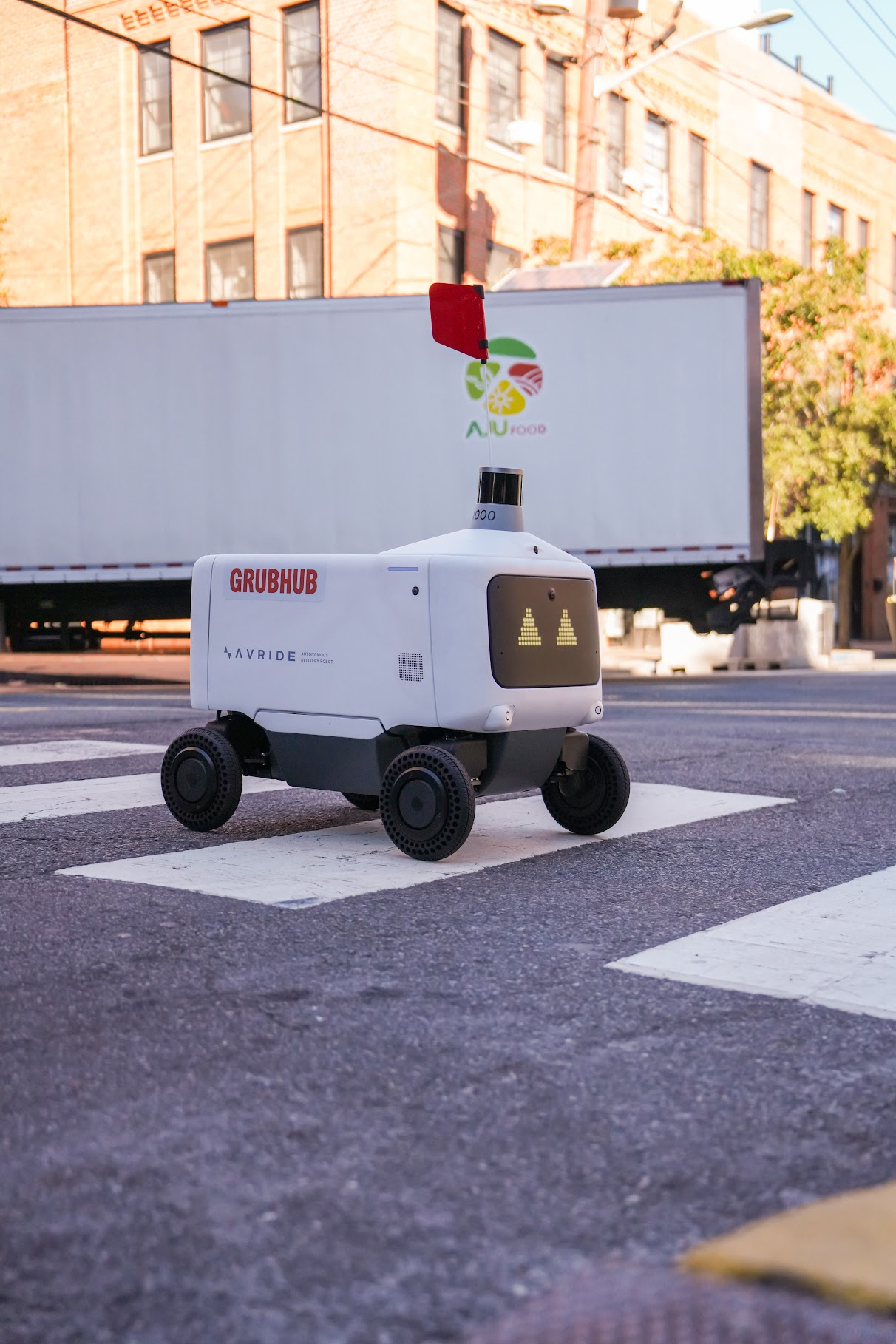
While the Empire State sorted out its e-bike issues, Grubhub just signed a novel agreement with the startup Avride to test delivery robots on the streets of Jersey City. This test comes on the heels of the company’s February announcement of the deployment of 100 Avride delivery robots on college campuses across North America.
As Anton Shingarev, Avride’s Head of Public Affairs, reflected, “Avride’s deployment at The Ohio State University is one of the largest autonomous delivery operations in the world. On an average week, the fleet completes more than 6,000 orders, reaching up to 1,600 deliveries per day during peak periods. More than 120 robots operate across the campus, serving tens of thousands of students, faculty, and staff. The scale of this program has allowed Avride and Grubhub to demonstrate how autonomous delivery can function reliably at city-like volume levels while maintaining safety and consistency.” According to Grubhub, The Ohio State University was one of 40 campuses across the country deploying autonomous terrestrial rovers.
Shingarev further explained how it prepared his company to tackle the urban challenges of the Garden State, “Delivering autonomously in a dense city like Jersey City presents a very different set of challenges compared to a controlled campus environment. The robots must safely navigate through mixed traffic, pedestrians, cyclists, and unpredictable street conditions, while also complying with local rules and ensuring they don’t block sidewalks or entrances. The built environment adds complexity — narrow sidewalks, uneven curbs, and frequent construction zones can all affect routing. To manage this, Avride uses detailed, high-resolution maps and adaptive routing systems that update continuously based on live data.” The company is also raising public awareness, as the Avride Public Affairs executive said, “People need to understand what the robots are doing and how to interact with them.”
This partnership comes a year after Wonder acquired Grubhub, and could be an example of what’s to come from the take-away magnate. As PJ Poykayil, SVP of Customer Delivery Operations at Wonder and Grubhub, said, “This pilot represents the next step in our mission to provide diners with fast, reliable, and delightful delivery experiences. By combining Grubhub’s marketplace, Wonder’s culinary innovation, and Avride’s advanced robotics, we’re delivering the future of convenience.”

GrubHub’s fleet of Avride robots at The Ohio State University. Source Avride
Besides the convenience factor, delivery robots reduce carbon emissions and the risk of accidents. As the Virginia Tech Transportation Institute reports, “The use of sidewalk robots or aerial drones removes some vehicles from the roadways, yielding more benefits. Moreover, the expectation is these vehicles will be electric-powered, reducing their carbon footprint. Finally, they provide safety benefits by reducing crashes and accidents resulting from human error. In fact, a 2021 Virginia Tech Transportation Institute study estimates the full-scale market penetration of occupantless vehicles would reduce national road fatalities and injuries by between 55 and 62 percent—saving about 34,000 American lives and avoiding four million injuries per year—with most of the reduction coming through the removal of occupants who were simply making a trip to a store for goods that could have been delivered.”
This premise is behind ff Venture Capital‘s portfolio company, Manna Air Delivery, which uses drones to deliver food orders in 3 minutes or less. As CEO Bobby Healy boasts, “Drone delivery is faster, quieter, more scalable, and safer, and it’s a far better experience for customers that want everything from groceries to takeaway food, to hot coffee you can get it in three minutes. The speed as well as the cost of operation is good, having been reduced to a tenth of a fraction in the last few years. It is so much more scalable, much better for small and big businesses, and much better for the consumer. Everything about it is superior to road-based delivery.” Manna competes with Zipline, Wing, Flytrex, and DroneUp for leadership of the skies.
A Happy Manna Drone Delivery Customer in Ireland. Source: The Mnya Creations
In addition to safety, profit margins are a prime driver of last-mile delivery automation. Healy reported to Forbes last April that its current drone delivery costs are around $4, with a human required to load 25 to 30 deliveries per hour while monitoring up to 20 drones. Manna aims to get it down to one dollar with high volume. Shingarev wouldn’t disclose Avride’s cost per trip; he did state, “Robot delivery helps make deliveries more affordable for customers. Lower delivery costs encourage more customers to use the service, which in turn supports local restaurants by increasing overall order volume on the marketplace.”
Robots might finally be having their moment right now, replacing overworked e-bike drivers who are forced to ride more aggressively to make a living wage. Avride and Manna imagine such professionals one day managing fleets of bots from the safety of a screen. No wonder hundreds of startups are aiming to capture market share of this multibillion-dollar industry, which is growing at a CAGR of over 22% to $10.3 billion by 2034 (market.us).

The big opportunity of automating last-mile delivery led Uber and Nebius to invest $375 million in Avride this past October. As Uber’s Global Head of Autonomous Mobility & Delivery, Sarfraz Maredia, expressed about the investment, “We’re excited to continue deepening our partnership with Avride and look forward to introducing their impressive autonomous driving technologies to more people in more markets.” AI-infrastructure leader Neibus Group’s CEO further endorsed his comments: “We’re delighted to welcome Uber as a strategic investor that shares Avride’s vision and will enable the company to move further and faster in pioneering AI-driven autonomous transportation.” The financing round’s partnership is more than just about delivering food, as Avride has big plans for autonomous taxis.

Avride’s robot is being filled with Wonder take-out for GrubHub customers in Jersey City, NJ. Source: Avride
In summing up what’s ahead for Avride, Shingarev exclaimed, “The next major step for Avride is the launch of its robotaxi service in Dallas, planned for December 2025. Alongside this, the company will continue expanding its delivery operations across both university campuses and urban environments, including growing our partnership with Grubhub in Jersey City following a successful pilot. Several new city and campus deployments are already planned for the coming months and into next year — so there’s much more to come. Stay tuned!”


Leave a Reply